
Jack Foster | Leather Explained
Not All Leather Is Created Equal — A Jack Foster Guide to Leather Grades
The leather goods market is full of misleading language. "Genuine leather." "Real leather." "Premium leather." These phrases appear on products ranging from handcrafted full-grain American goods to cheap imported accessories held together with glue and polyurethane — and they are used interchangeably in ways that obscure one critical truth: leather quality varies enormously, the grades mean specific things, and the difference between the best and the worst is not a matter of degree but a matter of material reality that shows up in performance, longevity, and the daily experience of owning the piece.
Here is what the grades actually mean, where they come from, and why Jack Foster builds exclusively from the top of the hierarchy.
The Anatomy of a Hide — Where Grades Come From
Every leather grade is determined by which layer of the original animal hide it was taken from and how much of that layer's natural character was preserved in processing. Understanding the layers explains everything else.
Not All Leather Is Created Equal — A Jack Foster Guide to Leather Grades
The leather goods market is full of misleading language. "Genuine leather." "Real leather." "Premium leather." These phrases appear across every price point — from handcrafted full-grain American goods to cheap imported accessories held together with glue and polyurethane. They are used interchangeably in ways that obscure one critical truth: leather quality varies enormously, the grades mean specific things, and the difference between the best and the worst is not a matter of degree but a difference in material reality that shows up in performance, longevity, and the daily experience of owning the piece.
Here is what the grades actually mean, where they come from, and why Jack Foster builds exclusively from the top of the hierarchy.---
The Grade Hierarchy — What Each Level Actually Means

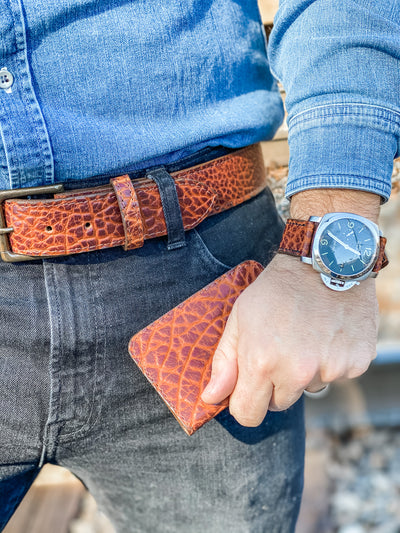
Full-grain leather is the highest grade available and the only grade Jack Foster uses. It comes from the topmost layer of the hide with the entire natural grain surface preserved — unsanded, unbuffed, and unaltered beyond the tanning process. Full-grain retains the tightest fiber density, the greatest tensile strength, and the surface character that develops into rich personal patina over years of daily use. The natural marks and pore structure are evidence of authenticity, not flaws to be corrected. Every Horween Dublin, Chromexcel, Badalassi Carlo Pueblo, and American Bison piece in the Jack Foster collection is full-grain — because nothing less is acceptable.
Top-grain leather is full-grain leather that has been lightly sanded to remove natural surface imperfections for a more uniform appearance. The sanding removes the strongest surface fibers — reducing abrasion resistance, breathability, and long-term patina potential. A surface coating is typically applied to compensate. It produces genuinely good results for certain applications but is not, and cannot be, full-grain leather.
Corrected-grain leather takes the sanding further — removing the natural surface character entirely and embossing an artificial grain pattern onto the substrate. Every hide looks identical. It ages with none of the depth or personal character of genuine full-grain leather. It is the leather of the mid-range fashion goods market.
"Genuine leather" is the most deliberately misleading term in the industry. It sounds like a quality assurance. It is not. In the leather goods trade, genuine leather is a specific designation for the third or fourth grade of leather — typically produced from split layers of the hide, heavily painted, and finished to resemble the surface it was separated from. It has lower tensile strength, essentially no patina potential, and a service life measured in years rather than decades. If a product's most prominent material claim is "genuine leather," treat it as insufficient information, not a reassurance.
Bonded leather is the particle board of the leather world — leather scraps, fiber waste, and leather dust mixed with polyurethane binders and pressed into sheets. It peels, cracks, and delaminates under daily use. It is not appropriate for any serious leather good.
PU or vegan leather is not leather in any material sense. It is a plastic film manufactured to approximate the visual appearance of leather without any of its biological structure, breathability, aging character, or long-term performance. It cannot develop patina. It delaminates under heat and repeated flex. It has no place in the Jack Foster vocabulary.
Tanning and Finish — The Other Half of the Quality Question
Beyond grade, two additional dimensions determine how leather performs and ages. Tanning method determines structural character — vegetable tanning produces firmer, more structured leather with exceptional patina potential, as seen in Horween, Badalassi Carlo, and Wickett & Craig production; chrome tanning produces softer, more flexible leather of good immediate performance but reduced aging character; combination tanning balances both, as in Horween's proprietary Chromexcel process. Surface finish determines how the leather looks and responds at the surface — aniline finishes preserve the natural surface with maximum patina development; semi-aniline adds light protection while maintaining natural character; pigmented finishes provide the greatest uniformity at the cost of the natural depth and aging quality that the finest leather goods are built around.
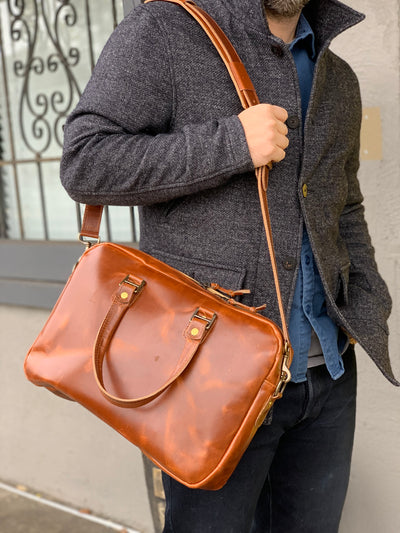
The pull-up leathers that define the Jack Foster material roster — Horween Dublin, Horween Chromexcel, Badalassi Carlo Pueblo and Wax, American Shrunken Bison — are all full-grain leathers with oil or wax-rich finishes that produce the characteristic pull-up effect: the lightening of the surface at flex and pressure points as the oils redistribute under wear, creating the dynamic, shifting color profile and the accelerated patina development that makes these leathers the most personally rewarding available in the leather goods world.
At Jack Foster, every material decision begins with grade — full-grain, without exception — and proceeds from there. The leather grade hierarchy is not marketing. It is material reality with permanent consequences for everything built from it. The person who understands it will never again pay full-grain prices for corrected-grain leather, or mistake "genuine leather" for quality, or accept anything less than the standard the finest leather goods have always been built on.
Full-grain. Always. The only grade worth building on.